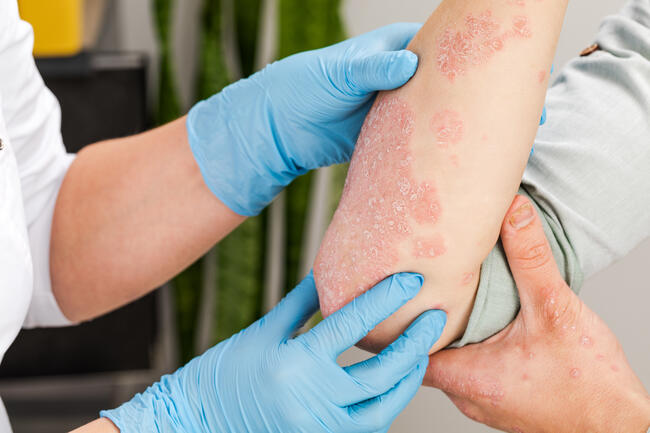










Energy-Based Devices in the Treatment of BCCs
Clinical Summary
Basal Cell Carcinoma (BCC): Energy-Based “Controlled Hyperthermia” as an Emerging Alternative
-
Device-based BCC treatment (FDA-approved, superficial/nodular BCC): Uses controlled hyperthermia (≈60 seconds to ~55°C) with pixel-level temperature monitoring and optical coherence tomography (OCT) for margin assessment.
-
Efficacy & outcomes: In CHAMP study (n=70 lesions), ~90% histologic clearance at 3 months; less invasive than Mohs (≈98% cure), with minimal downtime (10–12 days erythema/swelling) and no cutting/stitching.
-
Patient selection & role: Best for superficial/nodular BCC; avoid infiltrative, recurrent, or high-risk facial tumors (favor Mohs). Positioned as an alternative (not replacement), especially for older patients or those avoiding surgery.
Reviewed by Riya Gandhi, MA, Associate Editor of Immunology Group
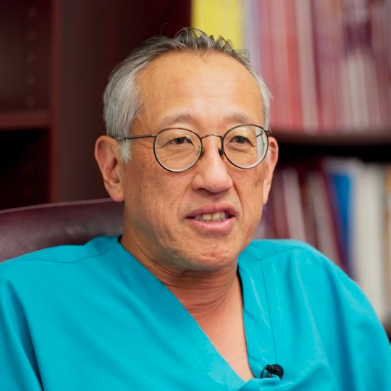
Dr Christopher Zachary discusses a novel energy-based approach to treating basal cell carcinoma using controlled hyperthermia and real-time thermal monitoring. Learn which BCC subtypes are best suited for device-based therapy, how outcomes compare with Mohs surgery, and how advances like optical coherence tomography and precision energy delivery may reshape future treatment options.
Transcript
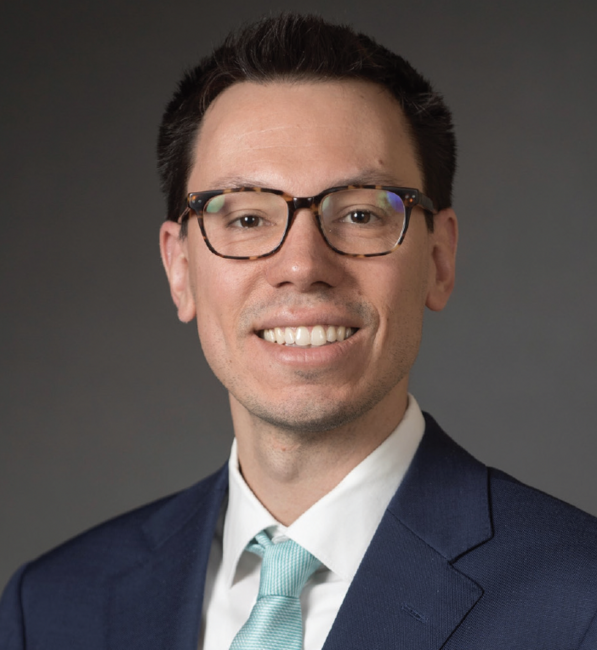
My name is Christopher Zachary. I'm professor and chair emeritus of the Department of Dermatology at UC Irvine. I was trained in Britain in dermatology and internal medicine, and I was trained in Ann Arbor in dermatologic and laser surgery. And it's been my pleasure to be at UC Irvine for the last 21 years.
When you talk about a "new approach" to treating BCCs with energy-based devices, what does that mean in practical terms?
Dr Zachary: That's an awfully good question because it takes time for new treatments to actually be accepted and be implemented. And so what I would say is that we are in the dark ages when it comes to electrodesiccation and curettage, which is one of the most common forms of treatment for basal cell cancer, for instance. And this new treatment introduces heat, very defined, very controlled heat. So we call it controlled hypothermia and monitored protocols. It happens to read out of CHAMP. And the reason for this is that we need to actually come into the 21st century. We need to adopt principles so that we actually understand what it is that we are entering to our patients that we're introduced into our patients. We would need to know how much energy we're giving to our patients. And we need to get a result that is dependable with good cosmesis, with as minimal healing as possible in terms of time and something that's acceptable to our patients.
Which BCC subtypes or patient profiles are best suited for device-based treatment versus surgery or systemic therapy?
Dr Zachary: For controlled hypothermia, which we have done extensive studies on between UCI and Henry Ford in Michigan, we've been looking at superficial and nodular basal cell cancers. And it is interesting that actually it's the nodular basal cancers that seem to do better than the superficial cancer. It's not too surprising. Even with the Mohs micrographic surgery, which is the gold standard, I'm a Mohs surgeon, and I think that Mohs is a great technique. But even with that, you have to do more stages with superficial BCC than with nodular. So not too surprising.
How do outcomes with energy-based treatments compare to traditional surgical approaches in terms of clearance, cosmesis, and recurrence?
Dr Zachary: So in terms of recurrence in particular, our first study, our first CHAMP study was on 70 lesions, 70 lesions and at 3 months post-laser treatment, we actually excise the areas and look for histological evidence of clearance or otherwise. And we essentially got 9 out of 10 patients who were clear of basal cell cancer at 3 months. And you might say, well, that doesn't really compare with Mohs. I must say Mohs is something like 98% successful. But for those patients who are 70, 80, 90 years old, who've had lots of excisions before, lots of Mohs, they've had cutting, they've had stitching. This doesn't involve any of that. It's simply 60 seconds of heating and there's no ulceration, there's no healing, there's no stitches. So it depends. With regard to how does it heal? If patients have excessive amount of heating, then they will blister. When we do electrodesiccation and curettage, we are causing an immediate blister and an ulcer, which takes 2, 3, 4 weeks to heal up with obvious scarring. This has the advantage is that generally speaking, in other ways, but generally speaking, there's just some heating, some swelling, redness that lasts for about 10, 12 days, and then it gradually pages away.
What technical advances - whether in instrumentation, image guidance, or energy delivery - are making this approach more viable?
Dr Zachary: It's a really good question. First of all, we used optical coherence tomography in order to ascertain the lateral margins and the deep margin for the tumor. Until now, people just guess where the margins are. That's not really good enough in 2026. With regard to how we heat the tissue, we actually use the long pulse 1064. Actually, nothing new in this. People, particularly in Europe, Germany use the long pulse 1064 for treating skin cancers, not infrequently. But the big difference is that on our system, we've got a special scanner. So we know the temperature on every single pixel, and so we can work out time and temperature, total thermal energy delivered to the tissue. That is key. And that gives us an Arrhenius dosage of one, which causes program cell death and which is a gradual affair. As I say, instead of cutting and stitching, just a gradual loss of vision.
What are the limitations or pitfalls clinicians should understand before incorporating device-based BCC treatment into practice?
Dr Zachary: Well, I think it is very important to know who your patient subgroup is. If you're dealing with a cancer which is infiltrative pattern on the nose, for instance, recurrent tumor, a large tumor, then you definitely want to go with Mohs. Mohs is an outstanding technique. I'm a Mohs surgeon, but I would say that I think that Mohs is tremendously overutilized in this country. If a little very small fitzels, absolutely not necessary. And something like this where you just press a button and have the tumor just disappear, I think a lot of people will be very interested in it.
Looking ahead, do you see energy-based treatments becoming adjunctive, alternative, or even frontline therapy for select BCC patients?
Dr Zachary: Well, to begin with, these are going to be alternative treatments. And as I say, excision and Mohs, electrodesiccation, these are the main methods that we treat basal cell cancers with. So this will be, we'll plug it in there as an alternative treatment, which if it goes the way I think it's going to go, will become of significant intros to those who perhaps have had many Mohs excisions before and would like to have no cutting, no stitching, et cetera. And so I think this is an alternative technique that will be introduced, and it depends. I mean, we're just about to start the second study, CHAMP2 study with the internal feedback mechanism. So we know the temperature of every single pixel in the treated area. And we know when we've reached an Arrhenius dosage of one, if you choose 1 or 1.2 or whatever, but you can give a defined amount of energy. The problem is that the current techniques, we are giving 10 times the amount of energy that you need, a hundred times, a thousand times the amount of energy, though it's not surprising that you get ulceration and scarring.
Are there any additional tips or insights regarding the energy-based approach for BCC?
Dr Zachary: Well, yes, I would say that a controlled hypothermia is of particular interest to people because Mohs surgery, for instance, requires, in my opinion, a one-year fellowship to be an expert at it. You don't absolutely require it, but if you want to be an expert. With this device, it's all in the device itself. The optical coherence tomography, that shows you where the cancer is. You simply press a button and you give 60 seconds to 55 degrees, and that's it. And I mean, I think that this will be delivered by the physicians, but actually I suspect that technicians will be delivering this type of energy controlled hypothermia in the future. For instance, radiation therapy, which requires 29, 30 separate visits to the clinic is often provided by an expert, a technician, of course, under the supervision of an attending. So I think that this may well have a lot of interest to people, but don't be in too much of a hurry. It'll probably be a year or so before this becomes primetime. But what I will say is that the FDA is just given approval for the use of this particular device and the treatment of superficial and nodular basal cell cancers.